
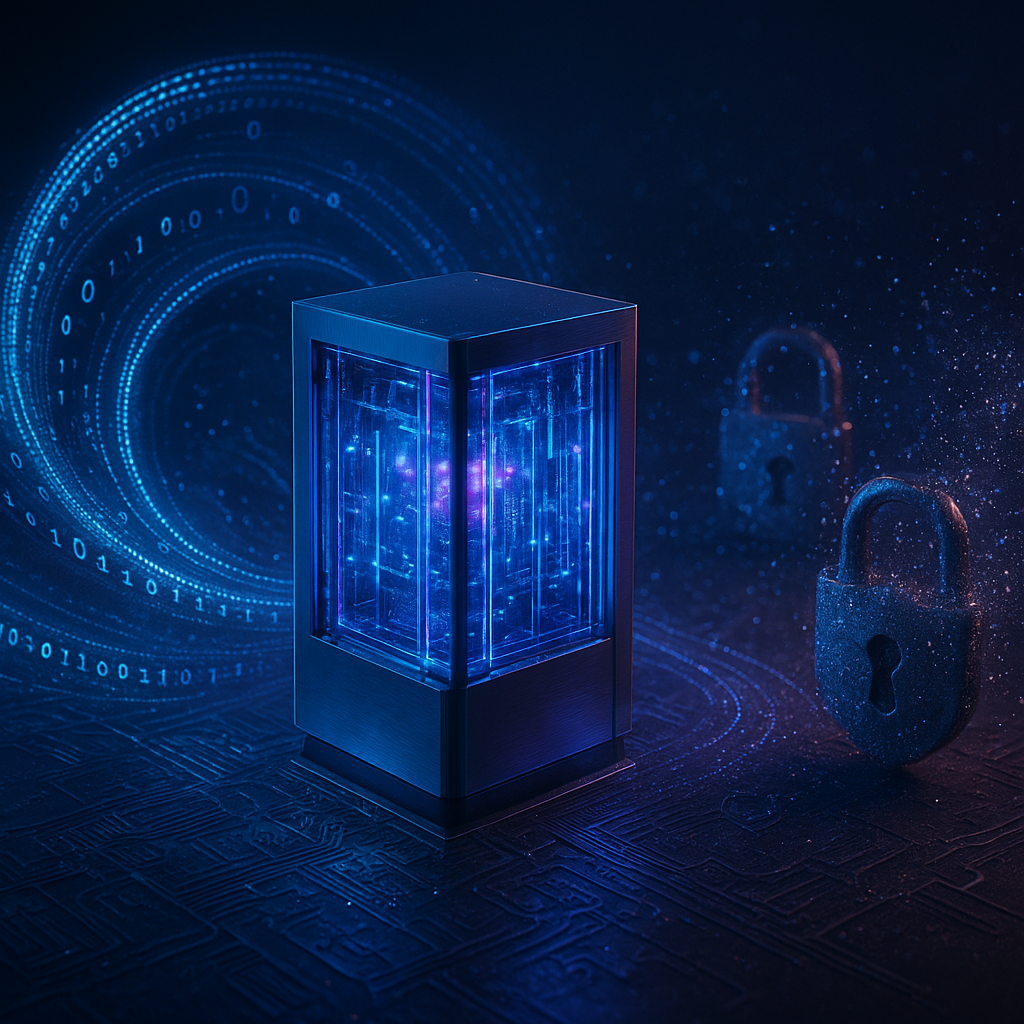
Quantum computing has moved from theoretical physics textbooks into real-world laboratories — and it’s advancing faster than most people expected. For the cybersecurity world, this shift carries enormous consequences. The encryption methods protecting everything from online banking to government communications were designed with classical computers in mind. Quantum computers play by entirely different rules, and that changes the threat landscape in profound ways.
This article breaks down what quantum computing actually means for cybersecurity, which specific threats are most pressing, and what organizations and individuals can do to prepare for a post-quantum world.
What Makes Quantum Computing Different — and Dangerous for Security
Classical computers process information in binary — everything is either a 0 or a 1. Quantum computers use qubits, which can exist as 0, 1, or both simultaneously through a phenomenon called superposition. Combine that with entanglement (where qubits are linked and influence each other regardless of distance) and interference (used to amplify correct answers and cancel incorrect ones), and you have a machine capable of solving certain problems exponentially faster than anything available today.
That extraordinary processing power is great for drug discovery, materials science, and financial modeling. But it’s a serious problem for cryptography.
Most of today’s encryption relies on mathematical problems that are trivially easy to perform one way but practically impossible to reverse — at least for classical computers. For example:
- RSA encryption is based on the difficulty of factoring large numbers into their prime components.
- Elliptic Curve Cryptography (ECC) relies on the complexity of the elliptic curve discrete logarithm problem.
- Diffie-Hellman key exchange depends on discrete logarithm problems being computationally infeasible to crack.
A sufficiently powerful quantum computer running Shor’s algorithm — developed by mathematician Peter Shor in 1994 — could theoretically break all three of these encryption systems in hours or even minutes. This isn’t a distant hypothetical. Researchers at institutions like MIT and Google have been steadily increasing qubit counts and reducing error rates, with IBM announcing plans to scale quantum systems to over 100,000 qubits within the coming years.
The “Harvest Now, Decrypt Later” Threat Is Already Here
One of the most overlooked quantum security threats isn’t waiting for quantum computers to mature — it’s already happening. Nation-state actors and sophisticated cybercriminals are believed to be engaged in what security experts call “harvest now, decrypt later” (HNDL) attacks.
The strategy is simple: intercept and store encrypted data today — financial records, classified communications, intellectual property — and wait until quantum computers are powerful enough to decrypt it. For information that retains its sensitivity for decades (think military secrets, personal health records, or long-term government strategies), this is a genuine and present danger.
The National Security Agency (NSA) and the Cybersecurity and Infrastructure Security Agency (CISA) have both issued warnings about this threat vector. CISA has explicitly stated that organizations should begin transitioning to quantum-resistant cryptography now, not when quantum computers become mainstream.
Which Encryption Standards Are Most at Risk?
Not all encryption is equally vulnerable. Understanding which standards face the greatest exposure helps organizations prioritize their response.
Asymmetric (Public-Key) Cryptography
This is where quantum computing poses the most immediate and severe threat. RSA, ECC, and Diffie-Hellman — the backbone of TLS/SSL protocols that secure virtually every HTTPS connection on the internet — are all considered vulnerable to Shor’s algorithm. The widely used RSA-2048 standard, currently considered secure against classical attacks, could potentially be broken by a large-scale quantum computer.

Symmetric Cryptography
Algorithms like AES (Advanced Encryption Standard) are more resilient, but not immune. Grover’s algorithm — another quantum algorithm — can effectively halve the key length’s security. AES-128, for example, would be reduced to approximately 64-bit security in a quantum world. The fix is relatively simple: doubling key lengths (e.g., moving from AES-128 to AES-256) maintains adequate security levels. Most security experts consider symmetric encryption, when implemented with longer keys, to be “quantum-resistant enough” for the near term.
Hash Functions
Cryptographic hash functions like SHA-256 and SHA-3 are used in digital signatures, certificate verification, and blockchain systems. Grover’s algorithm reduces their effective security too, but similar to symmetric encryption, using longer hash outputs (SHA-384 or SHA-512) largely addresses the concern.
Post-Quantum Cryptography: The Path Forward
The good news is that the cryptographic community hasn’t been sitting idle. Post-quantum cryptography (PQC) — also called quantum-resistant or quantum-safe cryptography — refers to cryptographic algorithms designed to be secure against both classical and quantum attacks.
In 2024, the National Institute of Standards and Technology (NIST) finalized its first set of post-quantum cryptographic standards after a rigorous multi-year evaluation process involving submissions from cryptographers worldwide. The selected algorithms include:
- CRYSTALS-Kyber (now standardized as ML-KEM) — for key encapsulation and encryption, based on lattice problems.
- CRYSTALS-Dilithium (now ML-DSA) — for digital signatures, also lattice-based.
- FALCON (FN-DSA) — a compact lattice-based signature algorithm.
- SPHINCS+ (SLH-DSA) — a hash-based signature scheme offering a different mathematical foundation as a backup option.
These algorithms rely on mathematical problems — such as lattice problems and hash functions — that are believed to be resistant to quantum attacks, even using known quantum algorithms. The fact that they’re built on different mathematical foundations than current standards is important: it means even an unexpected breakthrough in quantum computing wouldn’t necessarily compromise all of them simultaneously.
The Quantum Computing Cybersecurity Preparedness Act
Legislative action is beginning to catch up with technical reality. The Quantum Computing Cybersecurity Preparedness Act, signed into law in the United States in December 2022, requires federal agencies to inventory their cryptographic systems and begin migrating to post-quantum standards. This represents a significant policy acknowledgment that quantum threats require proactive rather than reactive responses.
The law directs the Office of Management and Budget (OMB) to develop migration guidelines and establishes a framework for prioritizing which federal systems need protection first. While this legislation applies specifically to U.S. federal agencies, it signals a broader shift in how governments and critical infrastructure operators are expected to approach quantum readiness.
For private sector organizations, this is a clear signal: regulators and standards bodies are moving toward mandatory quantum-resistant cryptography, and early preparation will be far less disruptive than a rushed response later.
Real-World Impact Across Industries
The consequences of quantum vulnerabilities aren’t abstract — they’re deeply practical across multiple sectors.
Financial Services
Banks and payment processors rely heavily on asymmetric cryptography to secure transactions, authenticate identities, and protect customer data. A quantum-capable adversary could potentially forge digital signatures, impersonate financial institutions, or decrypt historical transaction records. The financial sector has been among the first to begin evaluating post-quantum migration pathways.
Healthcare
Patient records, genomic data, and clinical research represent information that may remain sensitive for decades — exactly the type of data vulnerable to harvest-now-decrypt-later attacks. Healthcare organizations that store long-term sensitive data face a more urgent timeline for quantum-resistant transition than industries dealing primarily with short-lived data.
Critical Infrastructure
Power grids, water treatment systems, and transportation networks increasingly rely on encrypted communications between components. Vulnerabilities in these systems carry safety implications beyond data privacy, making quantum-resilient security a matter of public safety as much as cybersecurity.
Government and Defense
Classified communications, intelligence data, and military command systems face the highest stakes. Many governments classify information with sensitivity periods of 25 to 50 years, placing enormous pressure on intelligence agencies to accelerate the adoption of quantum-safe protocols.
What Organizations Should Do Right Now
Transitioning to post-quantum cryptography is a multi-year process, and waiting until quantum computers are “good enough” to be a threat is not a viable strategy — especially given harvest-now-decrypt-later risks. Here are concrete steps organizations should consider:
- Conduct a cryptographic inventory: Identify every system, application, and protocol that uses encryption. You can’t protect what you don’t know about.
- Assess data sensitivity timelines: Prioritize systems that handle long-lived sensitive data — these face the most urgent quantum risk.
- Follow NIST’s post-quantum standards: Begin planning migrations to NIST-standardized algorithms like ML-KEM and ML-DSA. Many major vendors are already releasing quantum-safe library updates.
- Adopt crypto-agility: Design systems so that cryptographic algorithms can be swapped out without rebuilding entire platforms. This flexibility is valuable regardless of quantum threats.
- Monitor threat intelligence: Stay current with developments from NIST, CISA, NSA, and equivalent bodies in other countries. The quantum threat landscape is evolving rapidly.
- Engage vendors: Ask hardware, software, and cloud providers for their quantum-readiness roadmaps. Migration will depend heavily on third-party support.
Quantum Computing and Cybersecurity: The Other Side of the Coin
While quantum computing threatens existing encryption, it also offers potential benefits for security. Quantum Key Distribution (QKD) uses quantum mechanical principles to create theoretically unbreakable encryption keys — any attempt to intercept a quantum key physically alters it, making eavesdropping detectable. China and several European nations have already deployed experimental QKD networks.
However, QKD faces significant practical limitations — it requires specialized hardware, works over limited distances, and is expensive to implement at scale. For most organizations, post-quantum cryptographic algorithms represent a more practical near-term solution than QKD.
Quantum computing is also being explored for threat detection, where its ability to analyze massive datasets could improve anomaly detection and accelerate pattern recognition in cybersecurity monitoring systems. The technology, in other words, is a dual-use challenge: the same capabilities that threaten security can also be harnessed to strengthen it. Much like AI is reshaping how we interact with technology at every level, quantum computing stands to fundamentally reorder both the threats we face and the tools we use to counter them.
Conclusion
Quantum computing represents one of the most significant shifts in the cybersecurity landscape in decades. The encryption systems protecting the internet’s most sensitive communications were not designed with quantum adversaries in mind — and as quantum hardware continues to mature, those protections will erode.
The threats are real and already present in the form of harvest-now-decrypt-later attacks. The most vulnerable systems are those relying on asymmetric cryptography — RSA, ECC, and Diffie-Hellman — while symmetric encryption and hash functions face more manageable risks addressable through longer key lengths.
The path forward is clear: NIST has published post-quantum cryptographic standards, legislation is driving federal agency transitions, and major technology vendors are beginning to implement quantum-safe libraries. For organizations of all sizes, the key takeaway is that quantum-readiness is a proactive discipline, not a reactive one. Starting the cryptographic inventory and migration planning process now — rather than waiting for a quantum threat to materialize — is the single most impactful step any security-conscious organization can take today.