
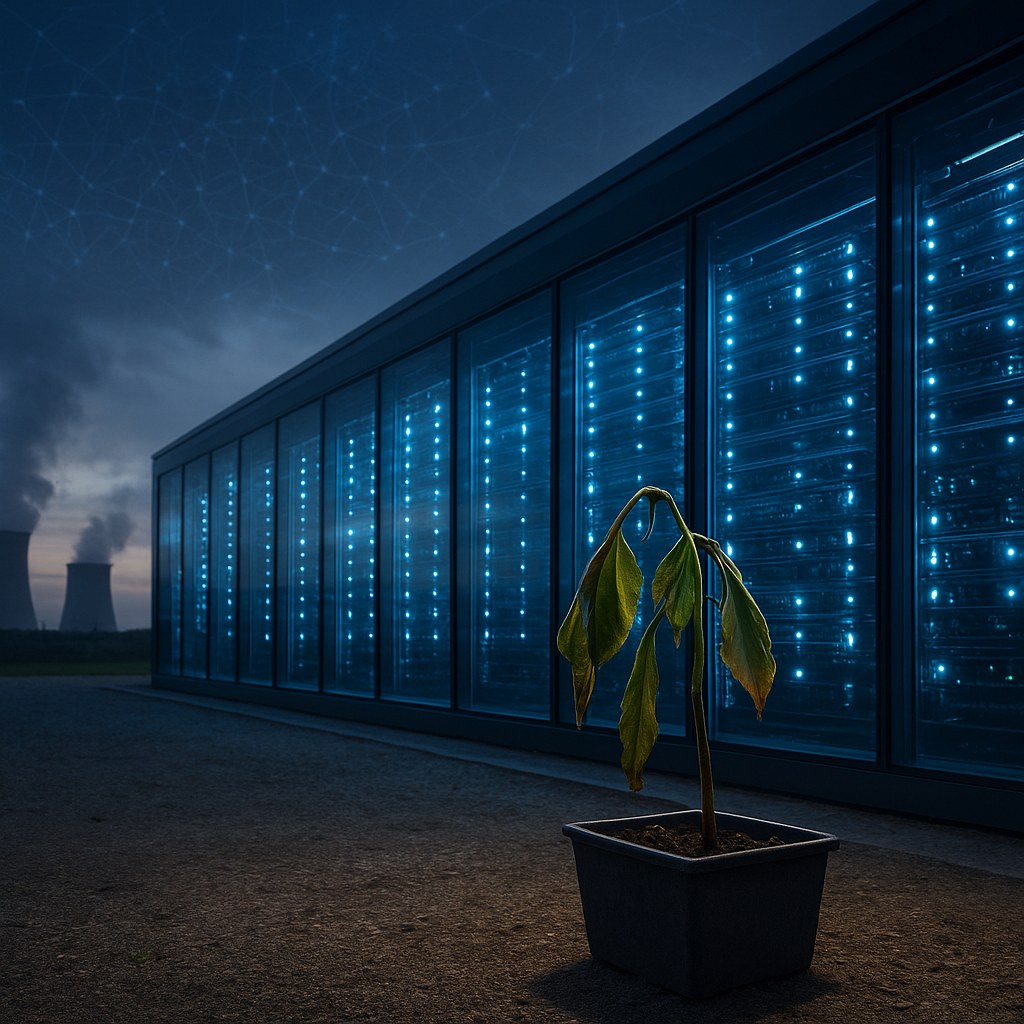
Every time you ask an AI chatbot a question, generate an image, or stream a video, a data center somewhere springs into action. These massive facilities — the physical backbone of our digital lives — consume staggering amounts of electricity and water, and their footprint is growing faster than almost any other industry on the planet.
While tech companies often tout their renewable energy commitments, the reality is more complicated. The explosive growth of artificial intelligence has pushed data center energy demand into overdrive, raising urgent questions about sustainability, community impact, and whether our digital infrastructure can keep pace with our climate goals.
Let’s dig into what’s actually happening behind the scenes — the good, the bad, and the genuinely concerning.
The Scale of the Problem: Data Centers by the Numbers
Data centers aren’t new, but their growth trajectory has shifted dramatically. According to the International Energy Agency (IEA), data centers consumed roughly 460 terawatt-hours (TWh) of electricity globally in 2022 — about 2% of total global electricity demand. By 2026, that figure is projected to more than double, potentially exceeding 1,000 TWh. To put that in perspective, that’s roughly equivalent to the entire electricity consumption of Japan.
The United States is ground zero for this expansion. The Department of Energy estimates that data centers consumed about 4.4% of total US electricity in 2023, and that share could climb to between 6.7% and 12% by 2028. Northern Virginia alone — often called “Data Center Alley” — hosts the largest concentration of data centers in the world, and local utilities are scrambling to keep up with demand.
What’s driving this surge? In a word: AI.
Why AI Changes Everything
Traditional computing workloads — hosting websites, running databases, processing transactions — were already energy-intensive. But AI workloads, particularly training large language models, operate on an entirely different scale.
Training a single large AI model can consume as much electricity as hundreds of American homes use in a year. A 2023 study published in Joule estimated that AI could account for 0.5% of global electricity consumption by 2027 — a figure comparable to the entire country of the Netherlands.
And it’s not just training. Every AI inference — every query you send to ChatGPT, every image you generate, every AI-powered search result — requires computational power. Google has acknowledged that integrating AI into search could increase the energy cost per query by a factor of ten or more compared to a traditional search.
The Water Footprint of Artificial Intelligence
When people think about data center environmental impact, electricity usually comes to mind first. But water consumption is arguably the more immediate and localized concern — and it’s one that directly affects communities.
Why Data Centers Need So Much Water
Data centers generate enormous amounts of heat. Thousands of servers packed into warehouses run around the clock, and without effective cooling, they’d overheat and fail within minutes. Most large facilities use evaporative cooling systems — essentially giant swamp coolers — that consume millions of gallons of water daily.
A single mid-sized data center can use anywhere from 300,000 to 5 million gallons of water per day, depending on its size and cooling technology. That’s comparable to the daily water usage of a town of 10,000 to 50,000 people.
Microsoft’s own environmental reports revealed that its global water consumption jumped 34% in a single year (2021 to 2022), largely driven by AI training workloads. Researchers at the University of California, Riverside estimated that training GPT-3 alone consumed roughly 700,000 liters of freshwater — enough to fill a small swimming pool — when accounting for both direct cooling and the water used in electricity generation.
The Local Impact
Here’s where it gets personal. Data centers are often built in areas where land and electricity are cheap — rural communities, agricultural regions, and areas already facing water stress. When a facility starts drawing millions of gallons from local aquifers or municipal water systems, it directly competes with farmers, residents, and ecosystems.
In The Dalles, Oregon, Google’s data centers have been the subject of legal battles over water usage transparency. In parts of Arizona and Nevada — states already dealing with severe drought — new data center proposals have faced fierce community opposition. Residents in some areas have reported declining well water levels and increased utility costs as data centers strain local infrastructure.
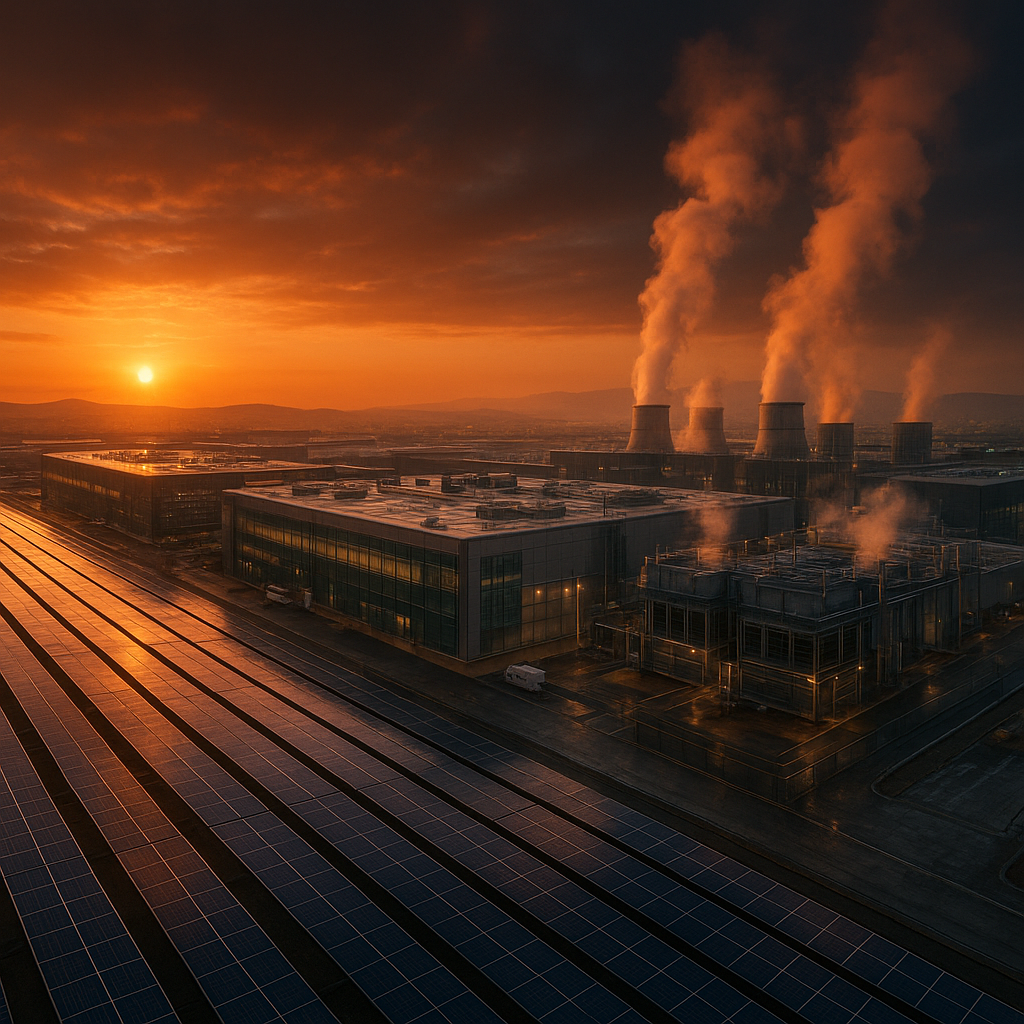
So when someone asks, “What is the water footprint of artificial intelligence?” — the honest answer is: significant, growing, and disproportionately borne by communities that often have little say in the matter.
Carbon Emissions: The Renewable Energy Paradox
Major tech companies love to highlight their renewable energy purchases. Google, Microsoft, Amazon, and Meta have all made bold commitments to carbon neutrality or 100% renewable energy. And to be fair, they’ve invested billions in wind and solar projects.
But there’s a catch — several, actually.
The Problem with Renewable Energy Credits
Most tech companies meet their renewable energy targets through power purchase agreements (PPAs) and renewable energy credits (RECs). These are essentially financial instruments that allow a company to claim it’s using clean energy even when the actual electrons powering its servers come from fossil fuels.
A data center in Virginia might run on a grid that’s 60% powered by natural gas and coal, but the company can purchase enough solar credits from a wind farm in Texas to claim it’s “100% renewable.” This accounting mechanism has been widely criticized for overstating actual emissions reductions.
The 24/7 Problem
Data centers need power around the clock. Solar panels don’t generate electricity at night, and wind turbines don’t spin when the air is still. Until large-scale battery storage becomes economically viable at grid scale, most data centers will continue to rely on fossil fuel backup — regardless of how many renewable credits they purchase.
Google has been more transparent than most about this challenge, acknowledging that its data centers achieved only about 64% carbon-free energy on an hourly basis in 2022. The company has set a goal of 24/7 carbon-free energy by 2030, but admits the technology and infrastructure to get there don’t fully exist yet.
Is ChatGPT or Google Worse for the Environment?
This is one of the most common questions people ask, and the answer is nuanced.
A traditional Google search consumes roughly 0.3 watt-hours of electricity. A single ChatGPT query, by contrast, is estimated to use between 2.9 and 10 watt-hours — potentially ten to thirty times more energy per interaction. If you multiply that by the hundreds of millions of queries ChatGPT handles daily, the numbers add up fast.
However, context matters. Google processes over 8.5 billion searches per day. Even at a lower per-query energy cost, the sheer volume means Google’s total energy footprint dwarfs ChatGPT’s — at least for now. As AI becomes integrated into more products and services, that calculus will shift.
The more useful framing isn’t “which is worse” but rather: how do we ensure that the growth of AI doesn’t outpace our ability to power it sustainably? Right now, we’re not doing a great job of answering that question.
Impact on Communities: Beyond Energy and Water
The environmental impact of data centers extends well beyond utility bills and carbon accounting. Communities living near these facilities face a range of quality-of-life concerns that rarely make headlines.
Noise Pollution
Data centers are loud. The constant hum of cooling systems, backup generators, and server fans can reach 70-80 decibels at the property line — comparable to standing next to a busy highway. Residents in Northern Virginia, Georgia, and other data center hotspots have filed complaints about chronic noise that disrupts sleep and daily life.
Air Quality and Diesel Generators
Every data center maintains banks of diesel backup generators to ensure uptime during power outages. These generators are tested regularly — sometimes weekly — and emit particulate matter, nitrogen oxides, and other pollutants. In areas with multiple data centers, the cumulative air quality impact can be significant.
Land Use and Habitat Disruption
A single hyperscale data center campus can span hundreds of acres. In rural areas, this means converting farmland, forests, or wetlands into industrial facilities. The construction process itself generates significant emissions and disrupts local ecosystems.
So, how far away from a data center is safe to live? There’s no universal standard, but most experts suggest that noise and air quality impacts diminish significantly beyond 500 to 1,000 feet. However, the indirect effects — water usage, grid strain, increased utility costs — can affect an entire region regardless of proximity.
Are Data Centers Good for a Community?
It’s not all negative. Data centers do bring tangible benefits, and dismissing them entirely would be dishonest.
- Tax revenue: Data centers generate substantial property tax income for local governments. In Loudoun County, Virginia, data centers contribute over $600 million annually in tax revenue — funding schools, roads, and public services.
- Construction jobs: Building a data center creates hundreds of temporary construction jobs, though permanent staffing is relatively minimal (a large facility might employ only 50-150 full-time workers).
- Infrastructure investment: Data center development often brings upgrades to local power grids, fiber optic networks, and roads that benefit the broader community.
- Economic anchor: In some rural areas, data centers provide an economic anchor that attracts additional investment and development.
The question isn’t whether data centers are inherently good or bad — it’s whether the benefits are distributed fairly and whether communities have a meaningful voice in the decision-making process. Too often, tax incentives and zoning approvals happen behind closed doors, with residents learning about a new facility only after construction begins.
Is AI Bad for the Environment in 2026?
The trajectory is concerning, but it’s not hopeless. Several developments could bend the curve:
Efficiency Improvements
Chip manufacturers are racing to build more energy-efficient processors specifically designed for AI workloads. NVIDIA’s latest GPUs deliver significantly more compute per watt than previous generations. Google’s custom TPU chips and Amazon’s Trainium processors follow a similar trajectory. If efficiency gains outpace demand growth, the environmental impact could stabilize.
Advanced Cooling Technologies
Liquid immersion cooling — where servers are submerged in non-conductive fluid — can reduce cooling energy consumption by up to 90% compared to traditional air cooling. Microsoft has experimented with underwater data centers, and several companies are exploring direct-to-chip liquid cooling that dramatically reduces both energy and water usage.
Smarter Siting and Scheduling
Some companies are beginning to shift non-urgent AI workloads to times and locations where renewable energy is abundant. Google’s “carbon-intelligent computing” platform automatically schedules compute tasks to coincide with peak solar and wind availability. This kind of flexibility could significantly reduce the carbon intensity of AI without requiring new infrastructure.
Regulatory Pressure
The European Union’s Energy Efficiency Directive now requires data centers to report energy and water usage publicly. Several US states are considering similar legislation. As transparency increases, so does accountability — and the incentive to improve.
What Can You Do?
Individual action won’t solve the data center sustainability crisis, but it’s not meaningless either. Here are a few practical steps:
- Be mindful of AI usage: You don’t need to stop using AI tools, but being intentional about when and how you use them matters. A quick Google search instead of an AI query for simple questions is a small but real energy saving.
- Support transparency: Advocate for policies that require data centers to disclose their energy and water consumption. You can’t manage what you can’t measure.
- Engage locally: If a data center is proposed in your community, attend public hearings. Ask about water sourcing, noise mitigation, and renewable energy commitments. Your voice matters more than you might think.
- Choose green cloud providers: If you’re a developer or business owner, consider hosting your workloads with providers that have strong sustainability track records and transparent reporting.
The Bottom Line
Data centers are the invisible engines of the modern internet, and AI is pushing them into overdrive. The environmental costs — massive electricity consumption, enormous water usage, carbon emissions, noise pollution, and community disruption — are real and growing.
At the same time, data centers bring economic benefits, and the technology industry is making genuine (if uneven) progress toward sustainability. The challenge is ensuring that growth doesn’t outpace our ability to power it cleanly, and that the communities hosting these facilities aren’t left bearing the costs while the benefits flow elsewhere.
The AI revolution doesn’t have to be an environmental disaster. But getting it right will require transparency, accountability, smarter technology, and a willingness to ask hard questions — even when the answers are uncomfortable.